
Before Intelligence Forgets Wisdom
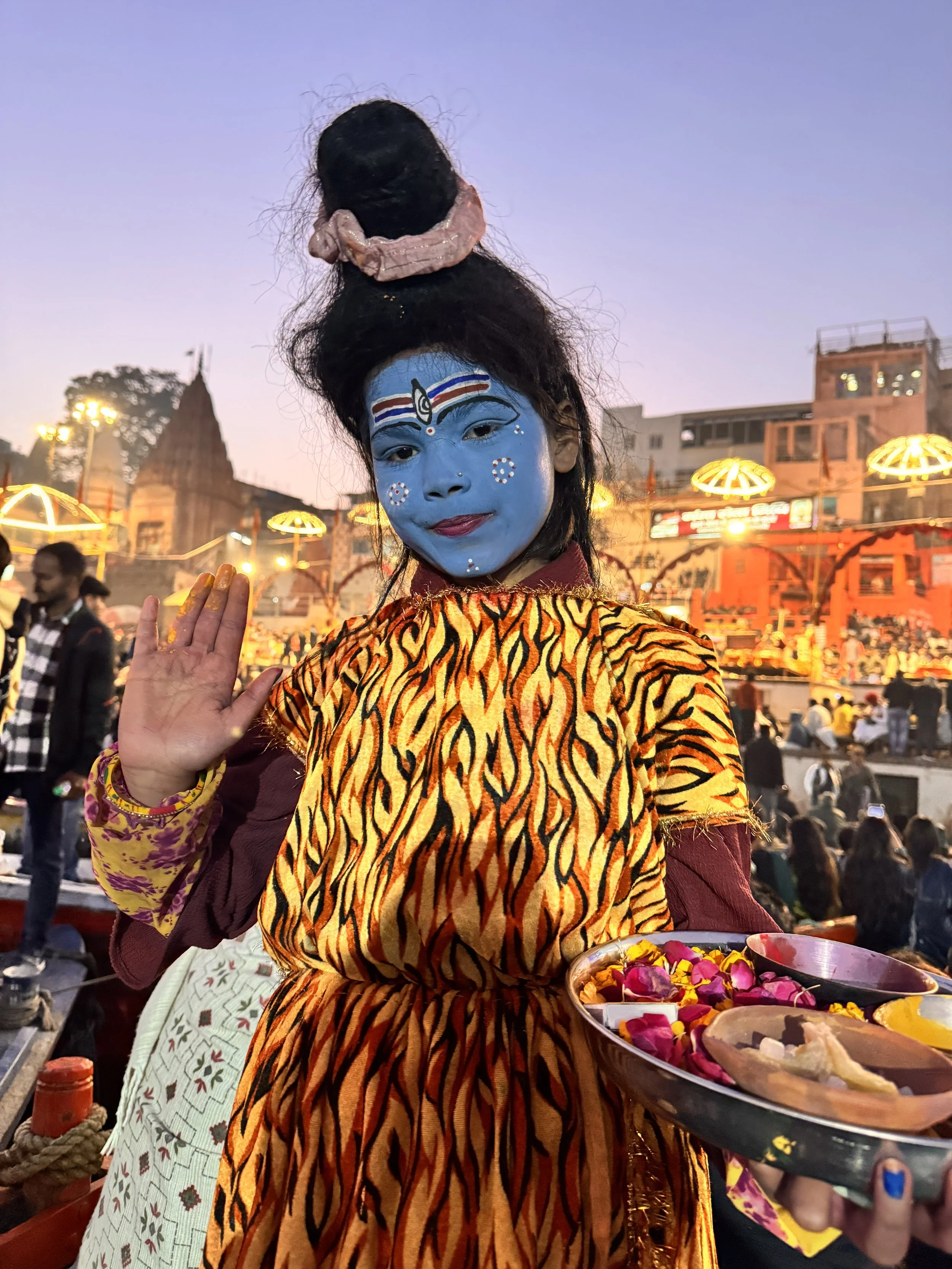
India is undoubtedly a feast for any curious, adventurous traveller. I've had the opportunity a few times, and I always returned home with more insight, wisdom, depth and gratitude. It's not an easy place to travel, and I can't fathom imagining the challenges of living in India. It's radically contrasting in terms of poverty, wealth, vastness, diversity, multiculturalism, multiethnicity, and spiritual multidimensionality. On one hand, it's a mess, it's chaos! On the other hand, it's dripping with meaning, life, death and an embodiment of spirituality like nowhere else.
On a mythical level, I was called to go to Varanasi, the luminous city of light. Also known as Kashi or Banares. A sacred city historically recorded for over 3000 years as the cradle of existence, of myth and of a cosmology of the whole. A place for all the gods to reside on earth. Kashi is seen and experienced as a microcosm of the whole world. As a spiritual seeker, my time had come to visit the holy city. I followed the call without reverence. I got in touch with my dear friend from 20 years ago, and soon after, Niraj and I were in a taxi to Asi Ghat.
I can't quite get over the chaos of moving through the cities in India. Conventional European rules and logic don't apply. It's a push-in, overtake, go faster, honk, cross in front type of mode that completely overrides the British " let's be kind, you can go first, please after you, no, I insist. Niraj explains that it's cultural, there are millions of people without work, close to poverty, and you have to fight for any opportunity to survive. You don't let someone pass to take a place ahead of you! You cross over the junction, turn right into oncoming traffic, swerve left to avoid the cow, brake, twist and accelerate in front of an old lady passing over the central reservation and honk continuously as you regain your side of the road whilst answering the phone as your mother is asking what you want for lunch. Perfectly normal!
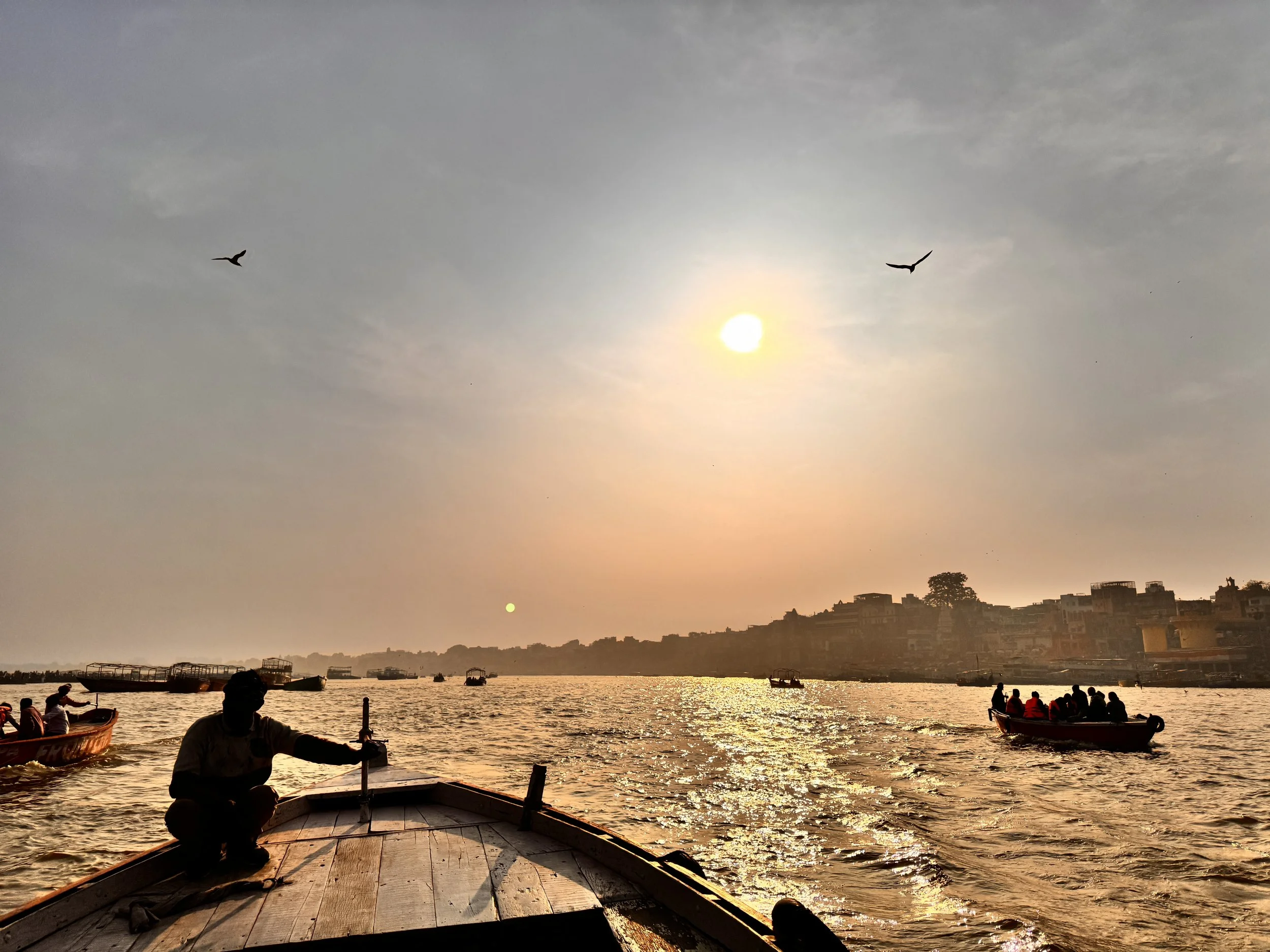
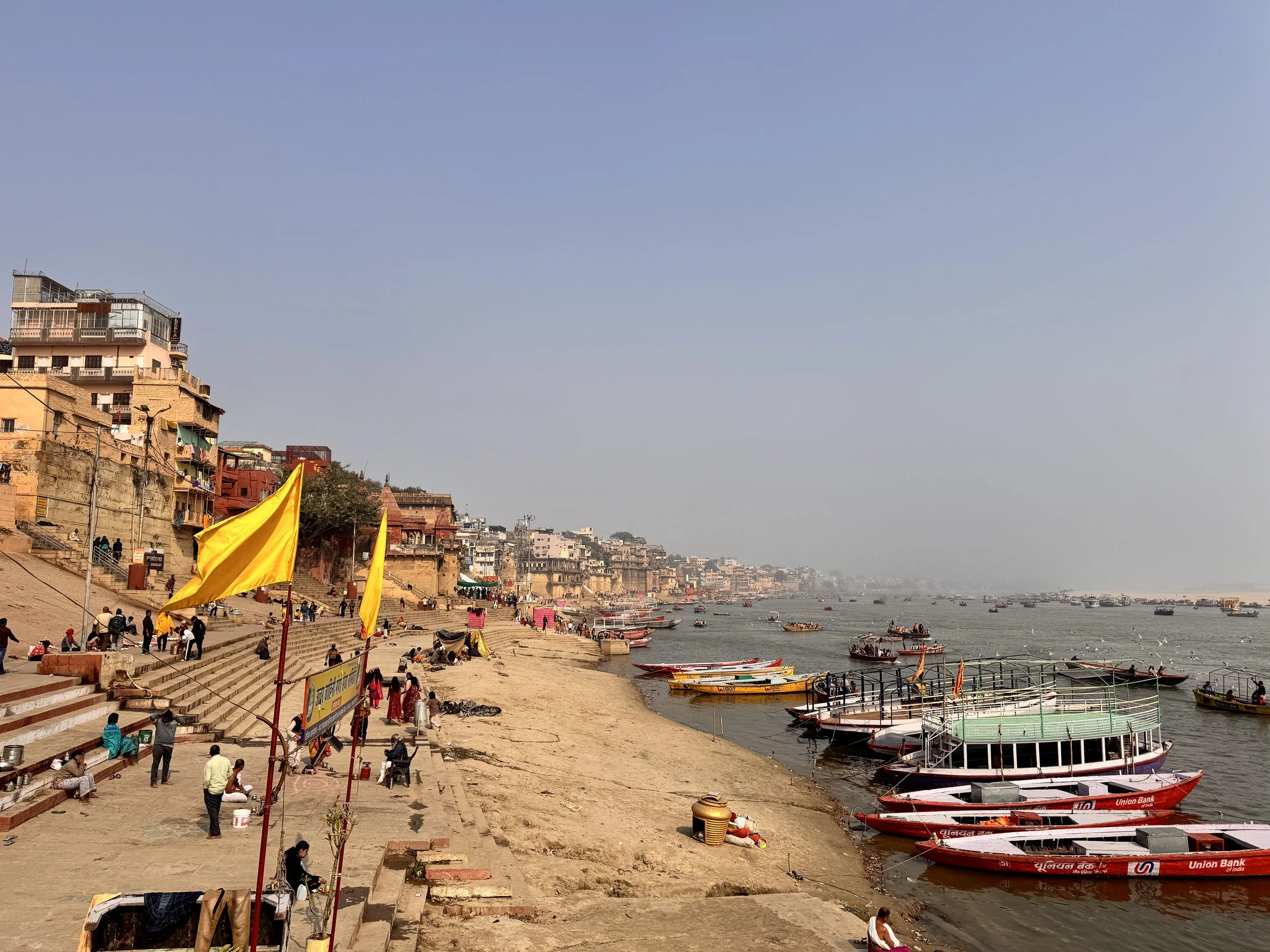
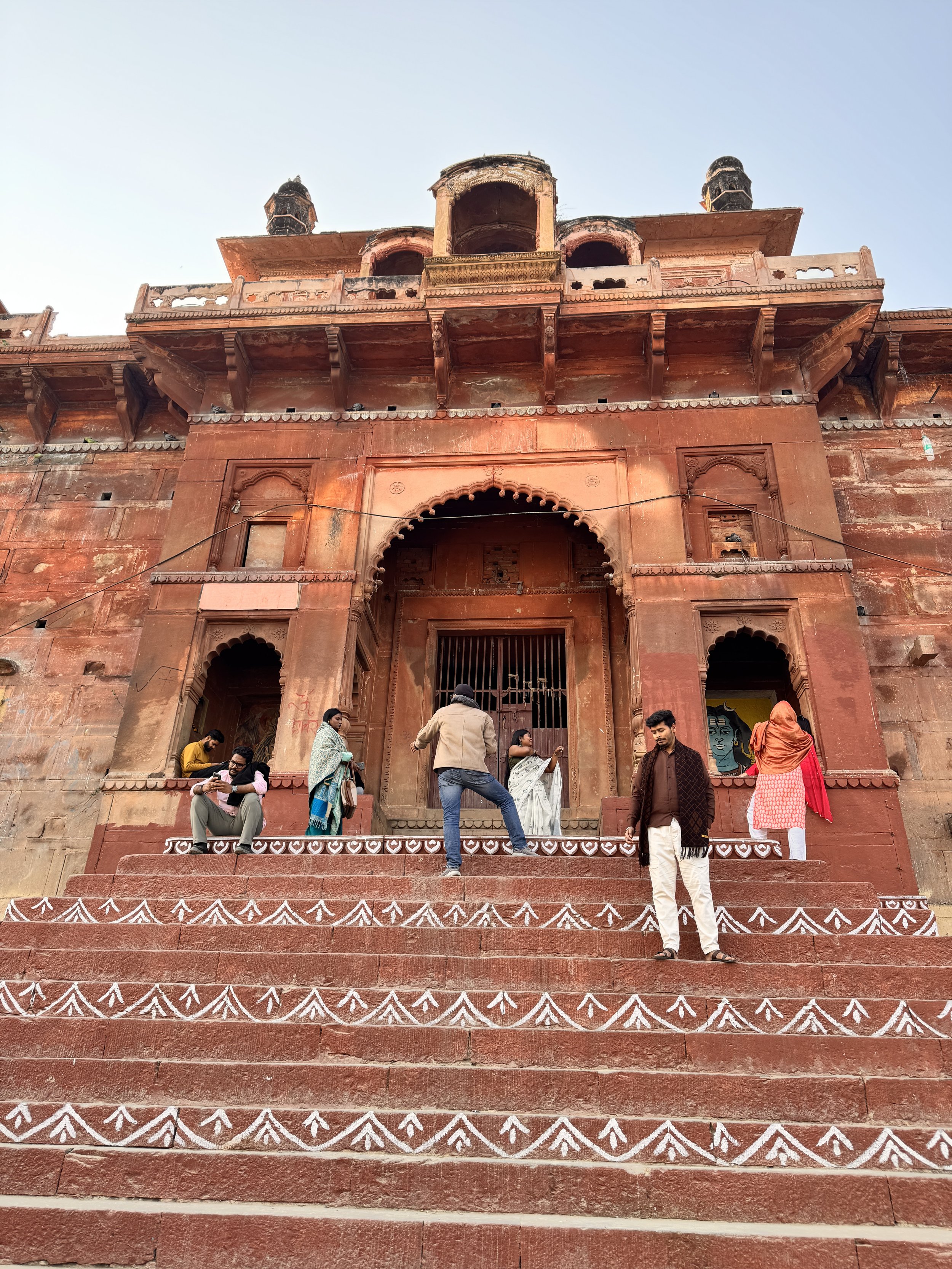
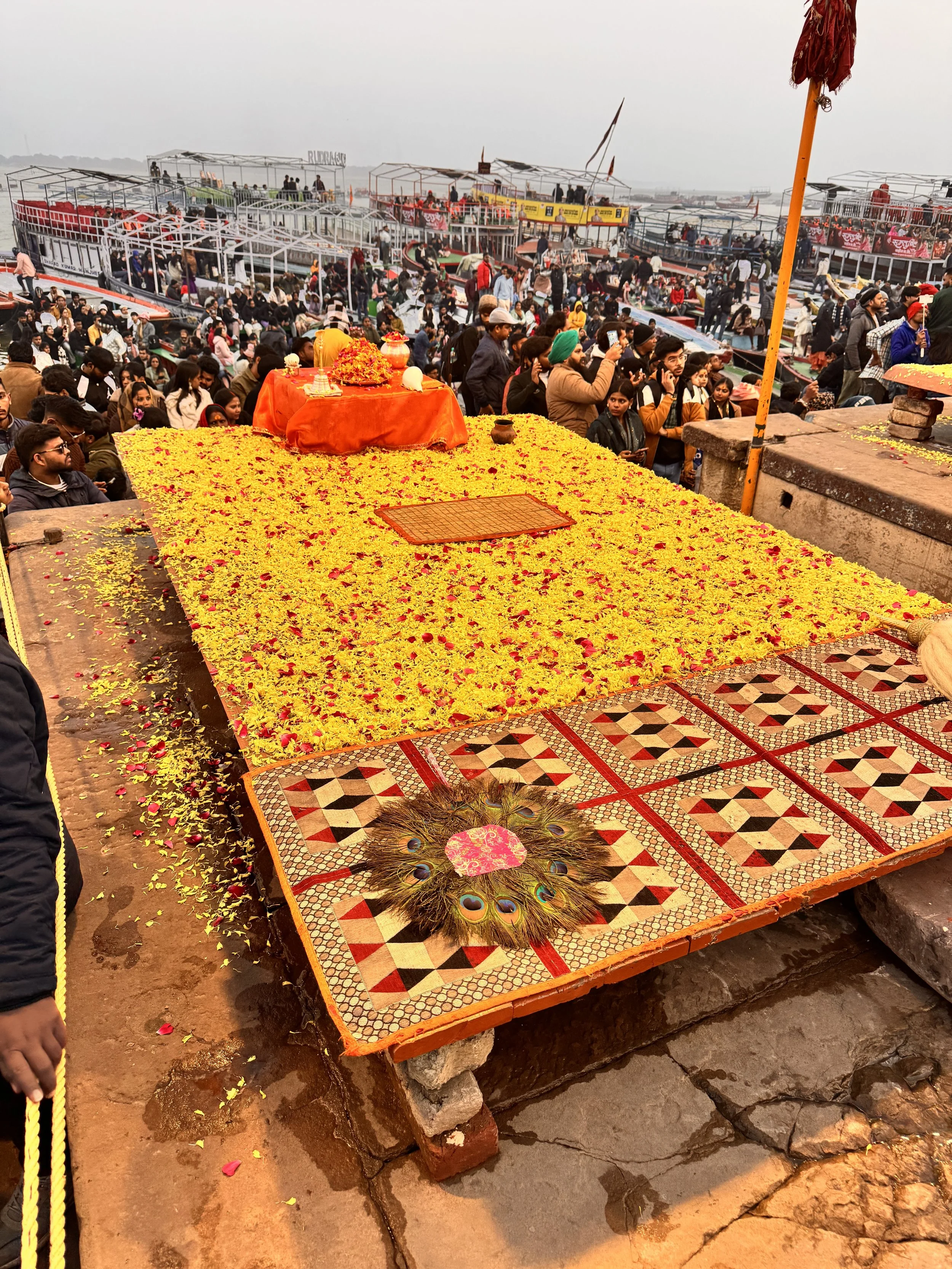
The first time our eyes met the Ganges from Asi Gaht, we were mesmerised. An endlessly hazed horizon fading into the emptiness of the sky, drawn down from a curvy meandering line playing between the ancient city's skyline, thriving down on a 3-mile continuum of steps leading to the water's edge, heaving with devotion, prayer and ritual. The river in all its divine presence was calm and recepient of what it was given, gracing those who bathed, receiving what was offered and listening to that which was asked. We were walking into something timeless, beyond history, beyond a conventional time, a fold in reality that would grant us an unforgettable experience, filled with grace, blessing and wisdom.
Like anywhere in India, you start with a cup of chai. Incredibly delicious, warm, sweet milk with tea, ginger and cardamom. It's a nectar of life. Here at this moment, we met Yaashaa, also visiting and well-versed in Varanasi. From here, as if grace had orchestrated our encounter, we spent the following 5 days letting the magic reveal itself as we met over and over, sharing insights and revelations.
For over 3000 years, pilgrims have continuously come to the sacred city to follow the path of the holy men and the renouncers: for seeing the city is seeing the gods. They say that Kashi is the permanent home of Shiva. He dwells there to bestow the enlightening wisdom of liberation. The city illuminates truth and reveals reality; it is the eternal light that intersects the earth.
It is said that Banares stands at the centre of the earth as the Place of creation, and gathers together the whole of the sacred universe in a single mandala. It is not an earthly city. Kashi is said to sit above the earth as a crossing place between this world and the "far shore" of the transcendent Brahman. The One Place with the nature of the supreme soul, of truth, luminous wisdom, and bliss.
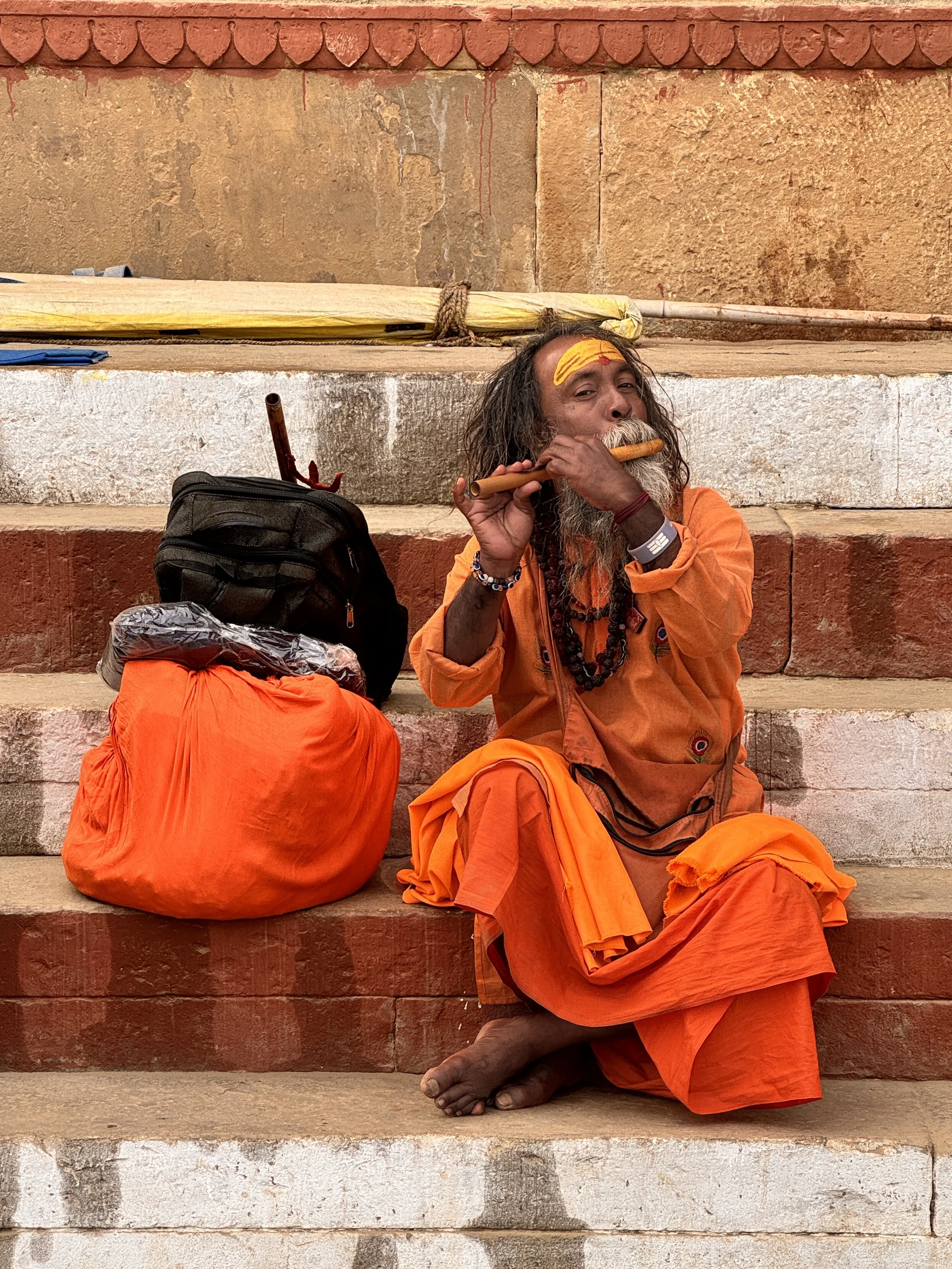
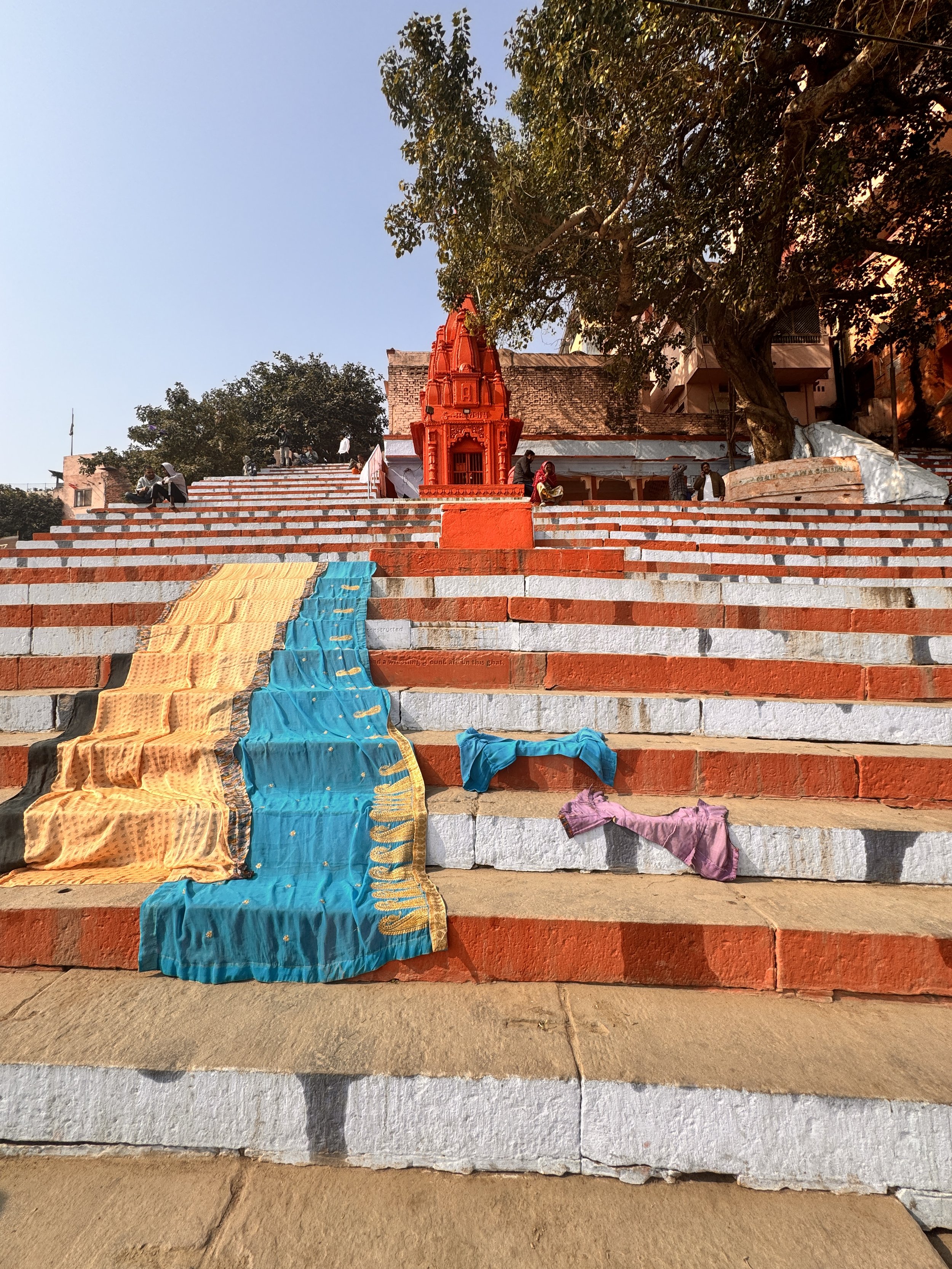
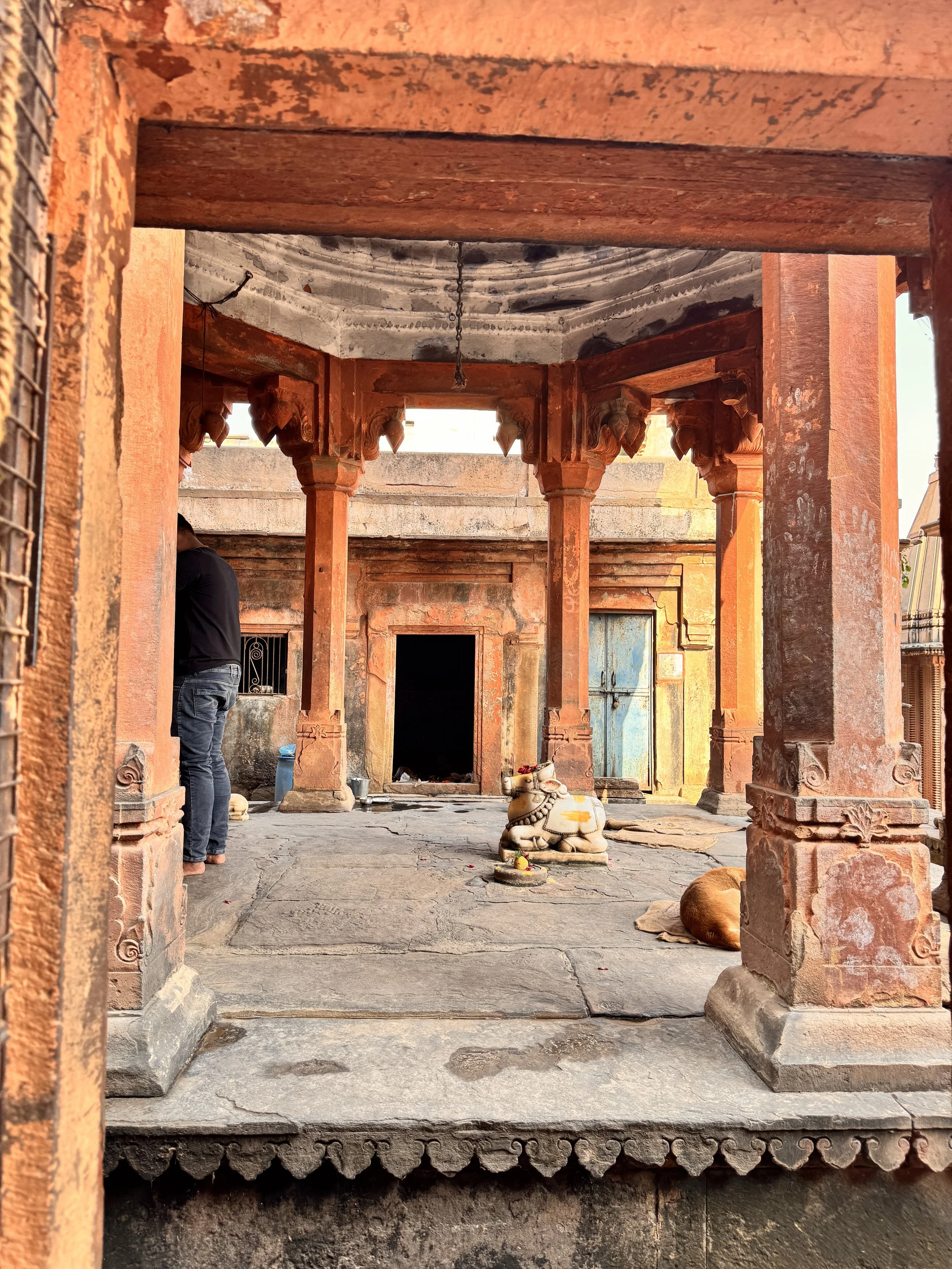
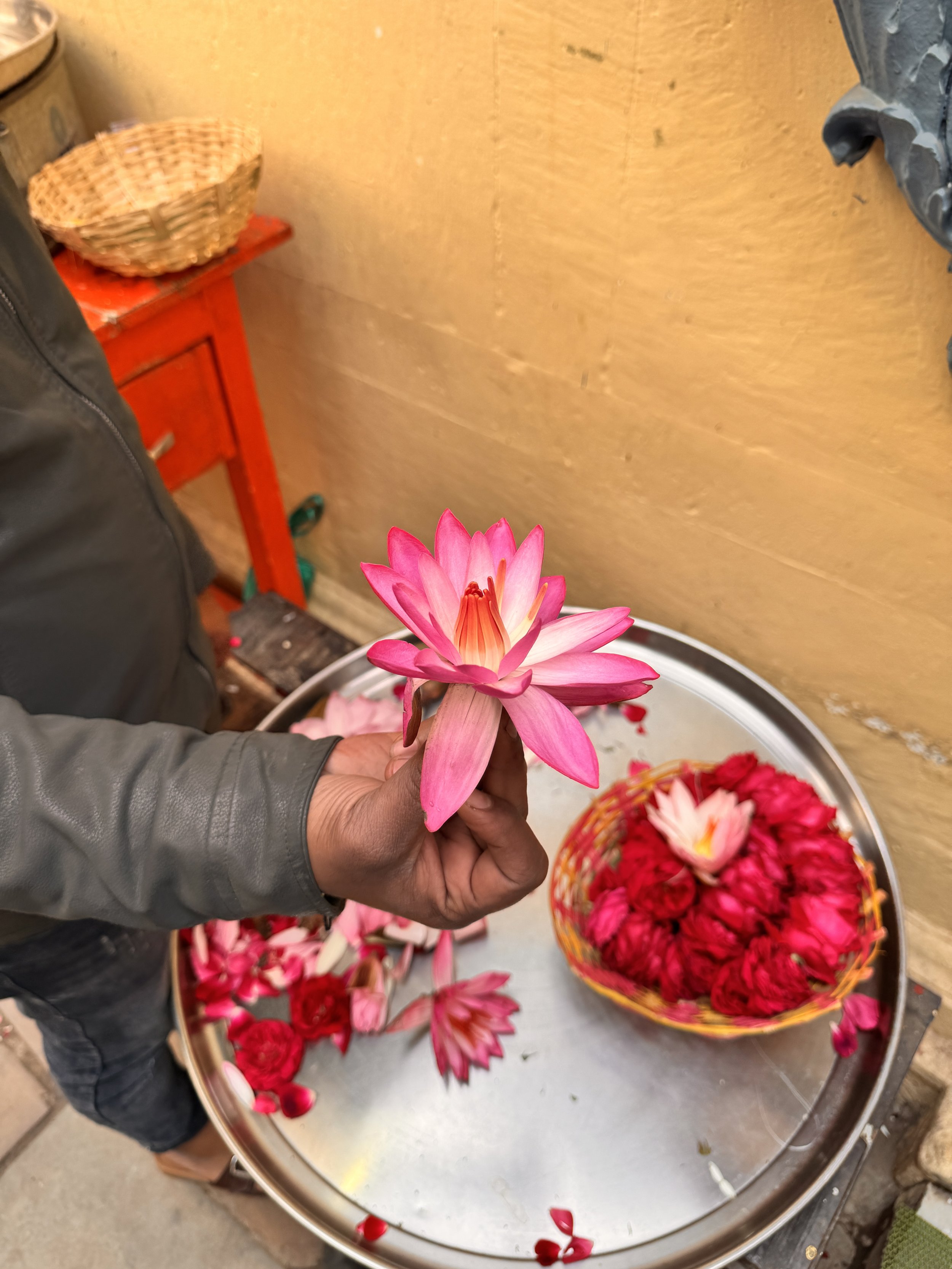
As we walked the edge of the city, along the steps leading down to the river, we passed countless shrines fed with milk, adorned with flowers, faces dabbed with vermillion, bodies covered with ashes, colourful saris draped over shoulders, monkeys nibbling, cows sleeping, urine festering and more to the point, bodies burning between logged tree trunks. Just there at the side of the procession, bodies burning. It was a firm impression I'll never forget. I tried not to look, but my eyes glanced. I asked myself what I was experiencing, and there was no reply. I felt the space and it responded, it was clarity, it was wisdom. I expected darkness, but instead there was light. As soon as we had passed the area, we all confirmed the same. For death in Kashi is liberation, it's not fear nor feared, it's desired! The privilege of dying there is said to release one from karmic rebirth into samsara, the cyclical unfolding of existence shaped by ignorance, attachment, and desire, in which life, death, and rebirth repeat as suffering, impermanence, and longing. To die in Kashi is to step beyond this wheel, beyond repetition, into freedom.
The Ganges flows from the Himalayas in the north-west to the Bay of Bengal in the south-east of India. Magically, as the sacred geometry of the landscape describes this path, it is in Varanasi that the river turns on itself and rather than running South it flows North. As it curves, a South-North axis drawn directly from the centre of the river meets the churning grounds. At a sacred geographical level, at the centre of the Axis Mundi sits the threshold point to Kashi, the linga of light and bliss, the transcendence to liberation - the vertical axis! The language of light is also the language of wisdom - enlightenment, the pure consciousness, the deep knowing and liberating insight for which many seek.
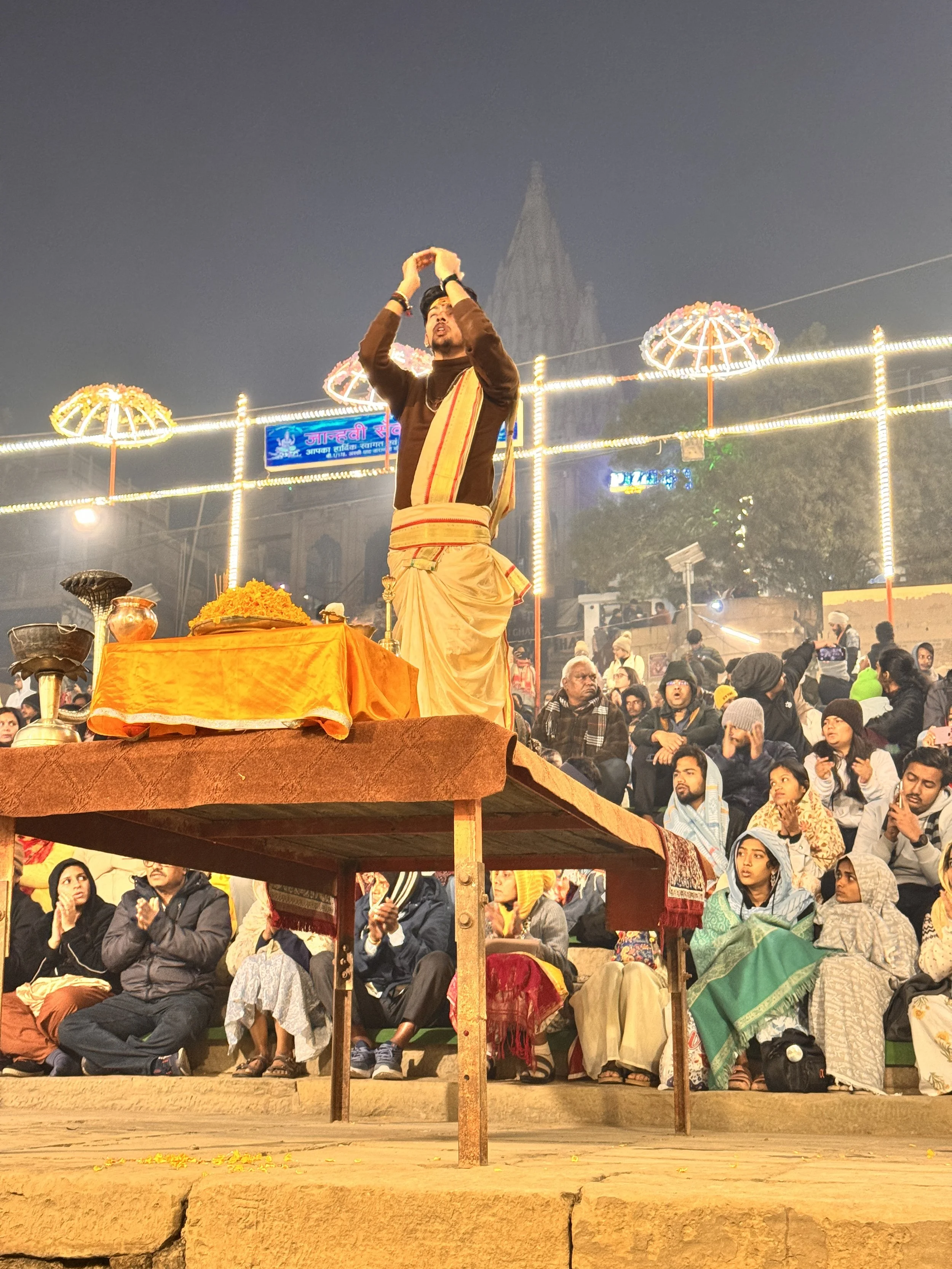
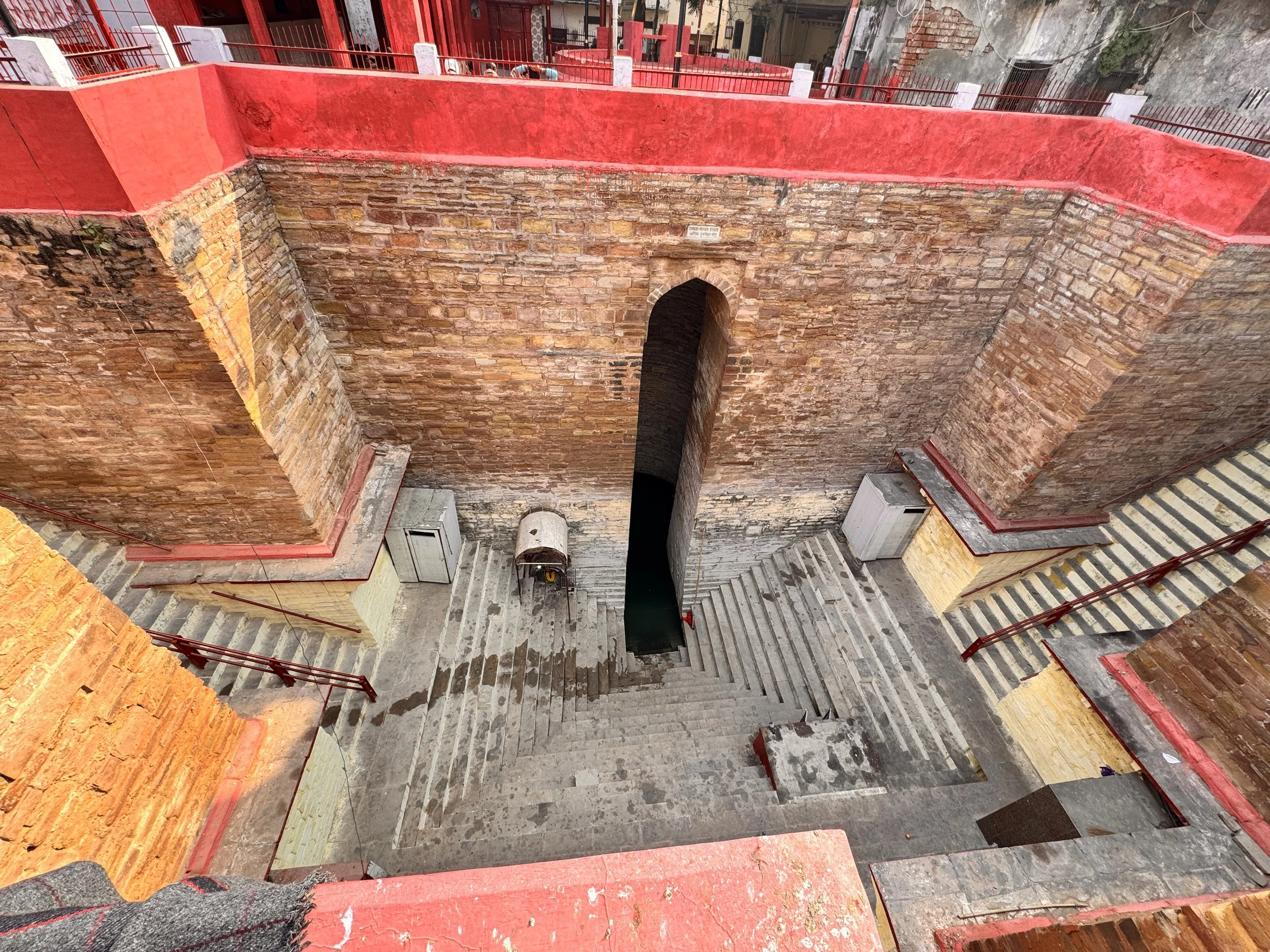
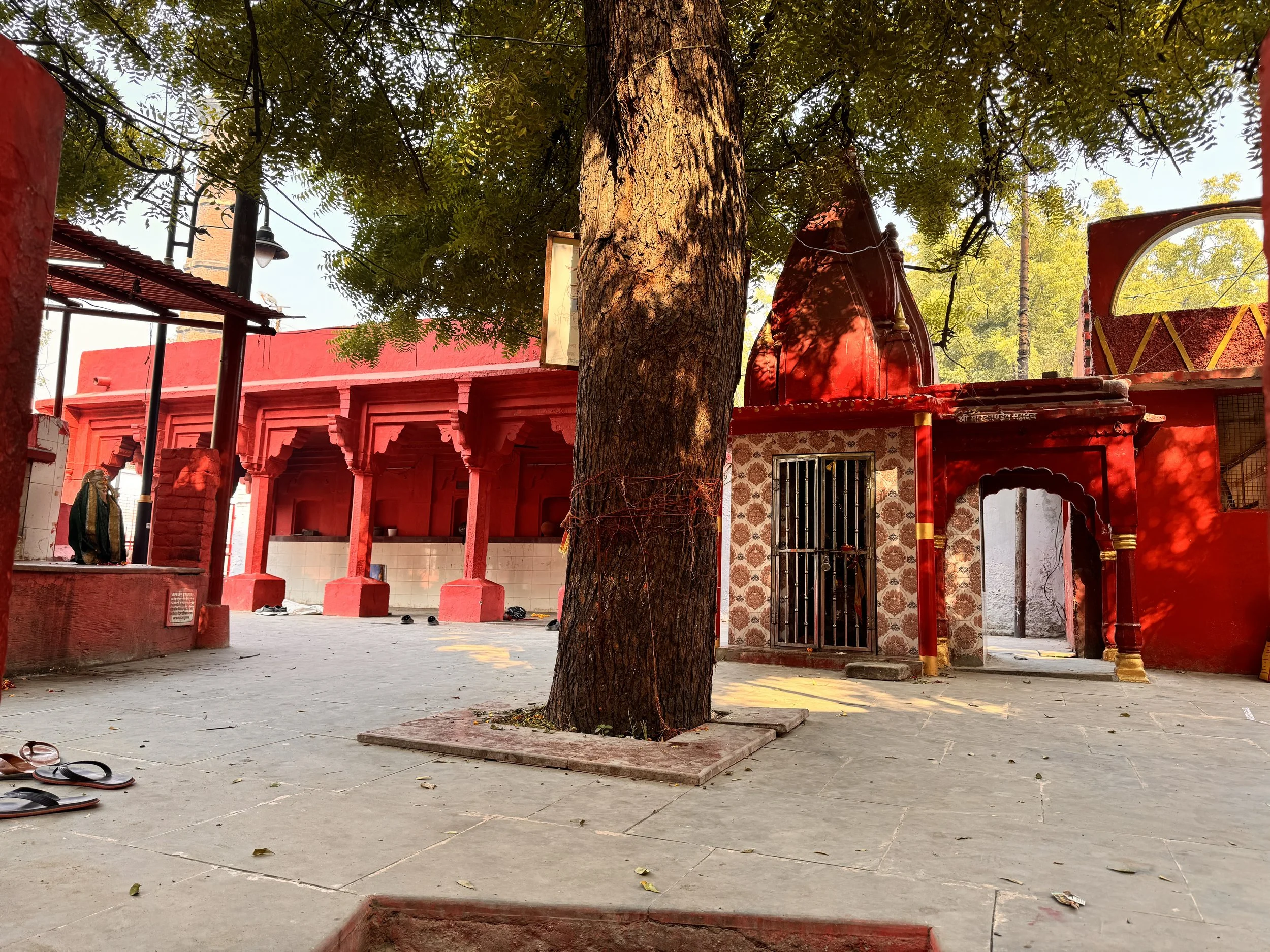
We walked the way of the pilgrims, experiencing the narrow alleys leading off the river. Countless temples and shrines, ashrams and homes encountered through tight passages, revealing the ancient fabric of thousands of years. It's alive and breathing with you. The city reveals the sacred in between the devoted rituals of prayer, offerings, myth-telling, and mantra recitation that resonate the diva's vibrations across the landscape of consciousness. Being in Varanasi is being inside the temple of god with many facets and expressions of all deities. You see all existence of human and non-human, for you see joy, anger, love, sadness, grief, rich and poor, healthy and sick, tall and short, fat and slim…. It's all there, it's life, it's death, it's destruction, it's renewal.
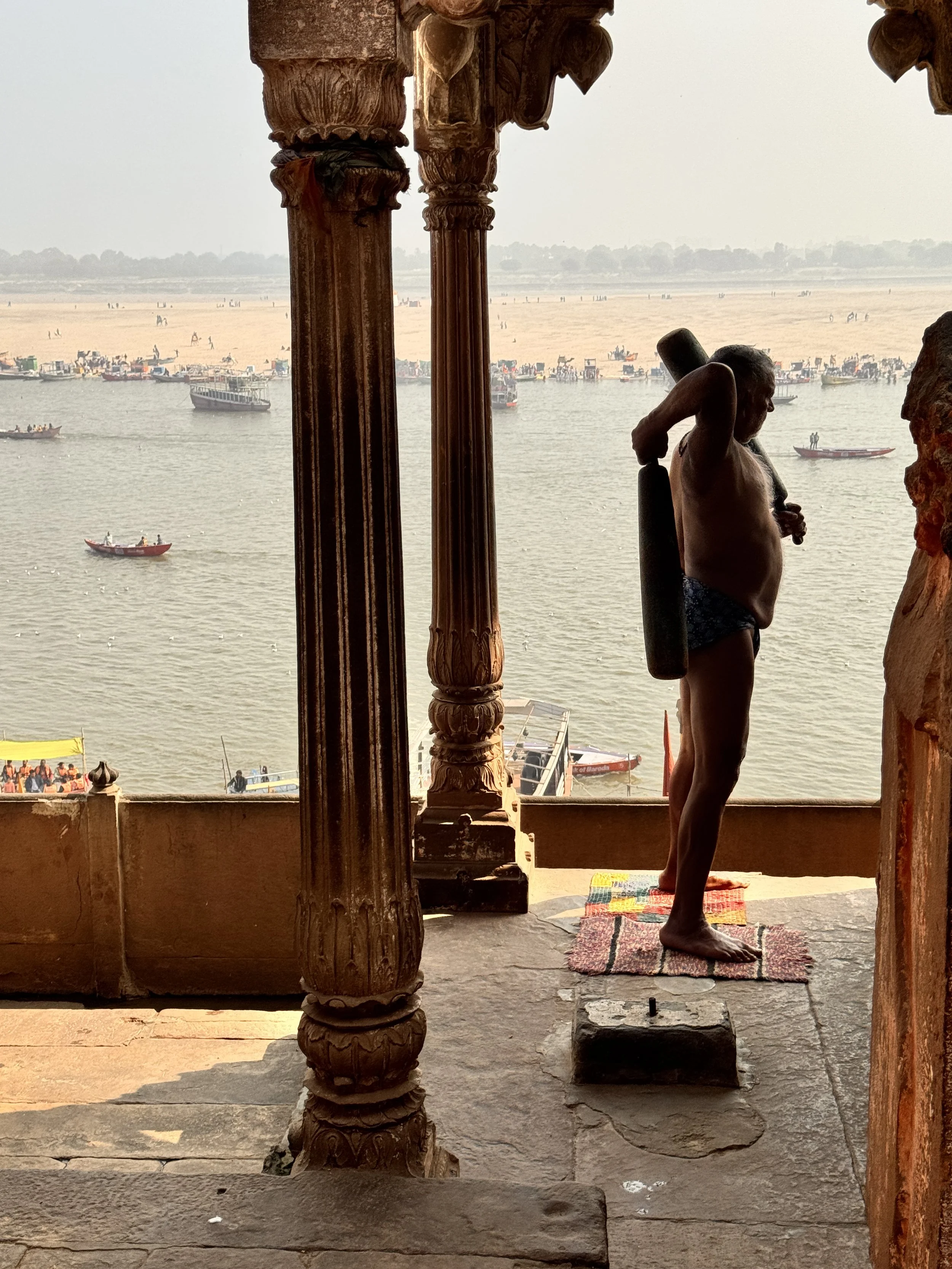
Varanasi is a living city, not a fossilised remnant of the past. The Hindu tradition is dynamic, adaptive and continuously re-enacted through practice. We were privileged to visit some of the key temples, attend the rituals, and be blessed by their sacredness. We approached the space without religious concepts or questions of belief. We bowed down, we touched feet, we circumnavigated, we listened, we prayed, we offered and importantly we meditated. The experiences were so powerful and alive that we would walk out of the temples desoriented, blissed out and feeling amazing. It truly is alive, and we experienced it.
Varanasi is known for being a good place to die, and it is precisely this that makes it a good place to live. We adjusted our focus from the rubbish on the streets, the honking of the bikes, and the smell of piss to more pleasurable exchanges. With Niraj, it's always a pleasure as he turns anything into a joke. We spent more time laughing out loud than speaking anything boring. We ate excellent food on the streets, from simple bread with spicy dal and chickpeas, to delicate milk sweets laced with silver, to frothy fermented milk with pistachio and saffron. It was a joy. The urban feel, the people and the Place felt great. No one pestered us for money; we walked the streets smiling as the city smiled back. Yaashaa introduced us to the best bookstore in this part of the world, and with his contacts, we went to places we wouldn't even have thought possible. "One cannot rush towards liberation through death for there is also pleasure to be enjoyed, wealth and power to be gained and religious duties to be performed. Only the ripening of the fruits of life is one truly ready for the fruits of death"
The Ganges is not a river of water, but a river of memory, devotion and hope. It's simultaneously a physical substance, a divine presence and a ritual medium. Equally, the sacred space that the river and the city define is not an object; it is an ongoing relational process enacted through ritual, movement, myth, and time.
Now that we have returned home, how can we make sense of thousands of years of meaningful rituals, prayers and liberation? How can the sacred be more expressed in our lives, in our modernity, in the technological era of AI? These are vast questions that we should try to answer elsewhere, yet I want to leave some thoughts.
The sacred is not a belief system or supernatural domain. It is a mode of relationality, of mediation. Ritual, ceremony, meditation, yoga, chanting, singing, etc are patterned practices, spaces and rhythms that orient human beings toward responsibility, continuity, humility and relational depth with each other, with Place, and with the more-than-human world. Indigenous traditions have long understood this. They treat knowledge as situated, time as cyclical, and agency as relational.
By contrast, AI systems mediate without lineage, without ritual. Accelerating abstraction and non-place, eroding embodied knowledge, temporal rhythm, and accountability. AI is not inherently destructive, but it is non-directional and unritualised. AI reshapes how the world appears to us. Therefore, we can learn from the sacred how we choose to be mediated, because without orientation, structure, direction, containment, commitment, discipline, and morality, we cannot find the sacred. The suggestion here is not to make AI sacred but to establish clear ways for a healthy relationship. The crisis is not intelligence but mediation. Varanasi has been doing this for 3000 years.
What India, and Varanasi in particular, ultimately offers is not an answer but an orientation. The chaos, the devotion, the intimacy with death, and the disciplined beauty of ritual all point back to a single core insight: meaning does not arise from efficiency, optimisation, or acceleration, but from right relationship. Kashi endures because it holds intelligence within form, wisdom within rhythm, and transcendence within daily life. In that sense, the city is not opposed to modernity or technology; it simply reveals what happens when relationship is embedded in cosmology, ethics, and embodiment. As we step deeper into an AI-shaped world, the question is not whether intelligence will increase, but whether our capacity for orientation will. Without ritual, without practices that slow, situate, and humble us, intelligence becomes unmoored. Varanasi reminds us that liberation is not escape, but an alignment between life and death. If AI is to serve us rather than empty us out, it must be met by humans who remember how to stand in relation to Place, to time, to each other, and to the mystery that no system can compute.
Bibliography
Eck, Diana L. Banaras: City of Light.New York: Columbia University Press, 1982 (rev. ed. 1999).
Parry, Jonathan. Death in Banaras. Cambridge: Cambridge University Press, 1994.
Eliade, Mircea. The Sacred and the Profane. New York: Harcourt, 1959.
